



Healthcare Inventory Automation: Which Approach Keeps Par Levels Right Between Counts
Healthcare
November 20, 2026

TL;DR: Four of the five common approaches to healthcare inventory automation measure something other than quantity. Barcodes record that an item moved. RFID records that an item exists. Cabinets record that somebody opened a drawer. Par rounds record what one person believed at 7 a.m. Weighing records how many are actually in the bin, which is why weight-based automation is the approach that holds a par level steady between physical counts. Here is the honest comparison, room by room.
The par sheet says 40 suture packs. The bin has 31.
Nobody did anything wrong. Three nurses pulled what they needed across a busy night, the pulls never got logged because logging was the eleventh priority at the time, and the sheet kept saying 40 until somebody walked the room with a clipboard two days later. By then the reorder had already been skipped.
That gap, between what the system believes and what is physically on the shelf, is the thing every approach below is trying to close. They close it in different places, at different costs, with different blind spots. Materials managers evaluating options get pitched all five as if they solve the same problem. They do not.
Most hospitals end up running two or three of these at once, and that is the right answer. The mistake is assuming the one you installed for implants is also covering the room where your variance actually lives.

Par rounds are still the default in most supply rooms, and they are not irrational. A tech walks the room, eyes each bin against a par level, writes what is short, and the replenishment list goes out. The cost is labor, and the labor is already on payroll.
What par rounds measure is a single moment. The number is right when the tech writes it down. Every pull after that is invisible until the next walk. In a room with real turnover, the par sheet is a historical document for most of the day, which is why the reorder trigger fires late and why the room runs short on the exact items that move fastest.
The second cost is the count itself. Controlled substances make this concrete. Under 21 CFR 1304.11, a registrant takes a new inventory of all controlled substances on hand at least every two years, and for opened commercial containers of Schedule I and II substances the rule calls for an exact count or measure of the contents. Schedule III, IV and V containers may be estimated, with one exception: a container holding more than 1,000 tablets or capsules requires an exact count.
Somebody is counting past a thousand capsules by hand. That is the task Cloudbox was built to remove. The Cloudbox scale station rolls to the shelf, the container goes on the scale, and the station converts the weight to a unit count using the per-unit weight already on file for that item, then records the measured quantity. The exact count stops being a person's afternoon and becomes a reading.
Barcode scanning moves the record from a daily walk to the moment of use. Staff scan the item as they take it, the system decrements, and the par level updates in something close to real time. For single-item, deliberate workflows, this works well and has for twenty years.
The failure mode is not technical. It is that a scan is a separate action from the work, and separate actions get skipped under load. One hand holding a tray, a glove on the other, a patient waiting: the scan is the thing that drops. The system then reports a par level that is confidently wrong, which is worse than a par sheet everyone knows is stale.
Scanning also has a quantity blind spot. A scan says the SKU moved. It does not say how many units moved unless somebody types the number, and the typed number is a human estimate dressed up as data. For a box of gloves that matters little. For a bin of connectors picked by the handful, the typed quantity is the variance.
RFID answers a different question well. A reader sweeps a cabinet or a room and returns what is present, by tag, without anyone touching anything. For implants, consigned devices and high-value components where every unit carries a serial and an expiry worth tracking, that is strong. Expired stock control is genuinely easier when each unit announces its own lot and date.
The limit is cost per unit. Tagging an individual suture pack, a single syringe or one box of caps costs more than the item earns. Hospitals solve this by tagging at the case or tray level, which gives presence of the tray but not the count inside it. The tray is there. Whether it holds twelve clamps or ten is still an open question, answered by opening it and counting.
RFID also tells you an item exists somewhere in read range. It does not tell you how many of a loose item sit in a bin, which is the question a par level actually asks.
Cabinets are the right tool for controlled substances and high-risk items at the point of care. Access is attributed, the transaction is timestamped, and the record supports the documentation DEA registrants are required to keep. Records and inventories must be maintained for at least two years and available for inspection, per 21 CFR 1304.04. A cabinet produces that record cleanly.
Two gaps show up in practice. The first is the override and the discrepancy queue: the cabinet records what the user declared, so a declared quantity that differs from what left the drawer becomes a discrepancy somebody reconciles later, by counting. The second is scope. The cabinet covers what is inside the cabinet. The bulk room that restocks it, the backup stock on the floor above, the overflow in the clean utility room: none of that is in the cabinet's record, and that is usually where the year-end variance is hiding.
Weight-based automation starts from the one property of a bin that correlates directly with how many units are in it. The Cloudbox scale station is mobile. It moves through the supply room, the container is set on the scale, the station weighs it, converts that weight into a unit count from the item's stored per-unit weight, and writes the measured quantity to the record. One station serves many containers and many SKUs, so a whole rack of items gets covered by a single piece of equipment rather than one device per bin.
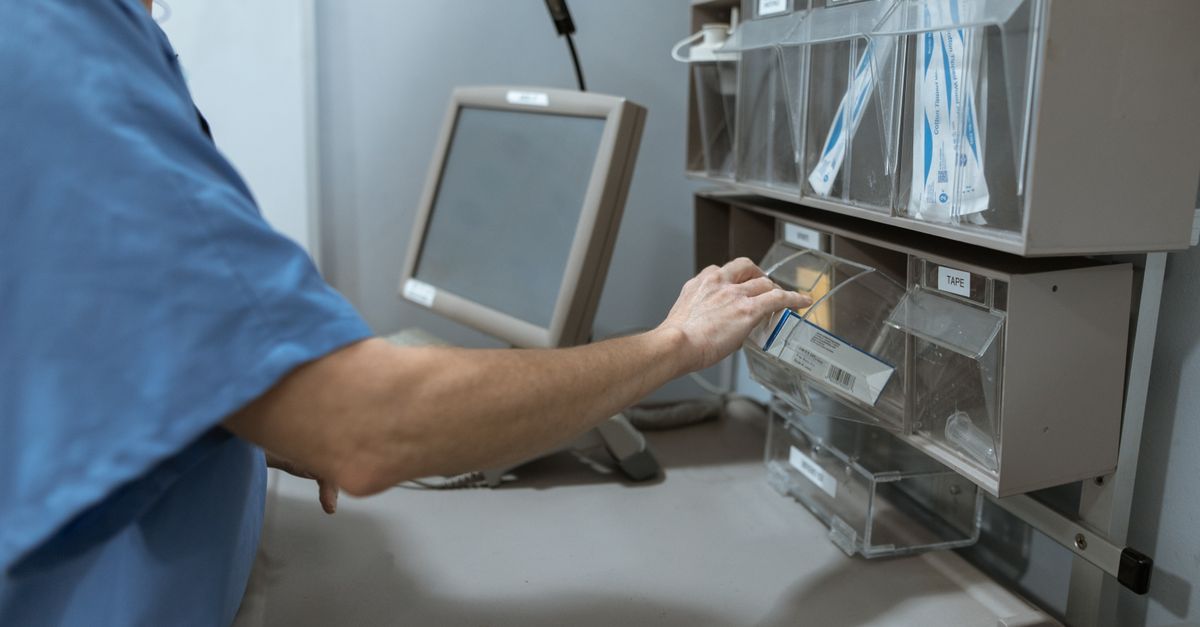
What changes operationally:
The objection worth answering: small, uniform items feel like the hardest case for weight. They are the easiest. Visual inspection fails on items that look alike, and a human count fails on items that come by the handful. A scale calibrated to the stored per-unit weight for that item does neither. The smaller and more uniform the unit, the more reliably the weight resolves to a count.
The serialized implant belongs to RFID and the cabinet. Rooms differ, and so should methods.
The question to take into a vendor conversation is not which approach is best. It is which room is generating your variance, and whether the tool you are being sold measures quantity or measures something adjacent to it and infers the rest.
If your variance lives in the bulk room, see what a measured count does to it. Talk to Cloudbox about your item list and how the stations would cover your rooms, or read how weight-based records support compliance documentation.
It is any system that keeps a supply room's recorded quantities current without a person walking the room and writing numbers down. The common approaches are barcode scanning at point of use, RFID tagging, automated dispensing cabinets and weight-based counting. They differ in what they actually measure: movement, presence, access or quantity.
For high-count, low-unit-value supply, weight-based counting is the most accurate because it measures quantity directly rather than inferring it from a scan or a declared number, which is how Cloudbox works. For serialized high-value items, RFID is stronger because identity and expiry matter more than count.
Better than counting by hand. The Cloudbox scale station weighs the container and converts the weight to a unit count using the per-unit weight stored for that item, so uniform small items resolve cleanly. One station covers many containers and SKUs across the room.
Under 21 CFR 1304.11, after the initial inventory a registrant must take a new inventory of all controlled substances on hand at least every two years, and may take it on any date within two years of the previous biennial inventory date.
For opened commercial containers, 21 CFR 1304.11 calls for an exact count or measure of the contents for Schedule I and II substances. Schedule III, IV and V containers may be estimated, except that a container holding more than 1,000 tablets or capsules requires an exact count.