


How to Improve Pick Accuracy on Bulk Fastener Orders in 5 Steps
Industrial
October 9, 2026

Nobody files a claim when you ship them extra.
That is the whole problem. A picker counting 1,400 hex nuts into a tote under a release deadline rounds up, because rounding up is the version of the mistake that never comes back. The customer gets 1,430, nobody notices, and thirty nuts leave the building for free. Do that across a few hundred line items a week and you have an expense that never appears on a line of your P&L. It shows up at year-end count as shrinkage, gets written off, and nobody connects it to the pick face.
This is for operations leads, warehouse managers and owners at hardware and fastener distributors: thousands of active SKUs, heavy overlap in thread pattern and finish, orders that run high line counts with hundreds or thousands of units per line. Improving pick accuracy in that environment is not a training problem. It is a measurement problem, and these five steps are the order to fix it in.
Start by splitting your variance into overs and unders, because they are different businesses.
Pull the last two quarters. Count shortage claims, the freight you paid to reship, and the customer service hours spent closing them out. That is your underfulfillment number, and it is the easy one, because customers report it for you.
Now go looking for the other half. Take twenty high-velocity SKUs, do a hard count at the bin, and compare to what your system says you should have. Where physical is lower than system and no claim exists, you shipped it out the door in somebody's tote. That is your overfulfillment, and on fasteners it is usually the larger of the two.

Pro tip: do the hard count on a Friday afternoon, after a week of normal volume, not Monday morning after a weekend of nothing moving. You want the number under load.
Weigh a sample, not a single piece.
Take 100 units of a SKU, weigh the lot, divide. One bolt weighed alone carries too much of the scale's own rounding to be trusted as a divisor. The federal reference here is NIST Handbook 44, Section 2.20, which sorts commercial weighing devices into accuracy classes I through IIII and sets the verification division for each. A Class III floor scale with a division sized for pallets of bulk stock will not resolve a single washer, and it does not need to. It needs to resolve the difference between 1,400 units and 1,430.
Catalog weights from your supplier are a starting point and not an answer. Finish, plating and lot-to-lot tolerance all move the real number. Weigh your own stock.
Pro tip: record the sample weight, the sample size and the date you took it. When a vendor changes plating and your counts drift, that record is how you find it in an afternoon instead of a quarter. The 2026 edition of Handbook 44 is the current reference if you are specifying new equipment.
Put the scale on wheels.
This is where most weight-based accuracy programs die. An operation buys a good bench scale, bolts it to a table near shipping, and asks pickers to walk product across the building to verify it. The workflow doubles in steps, throughput drops, and within six weeks the scale is a place where people set their coffee.
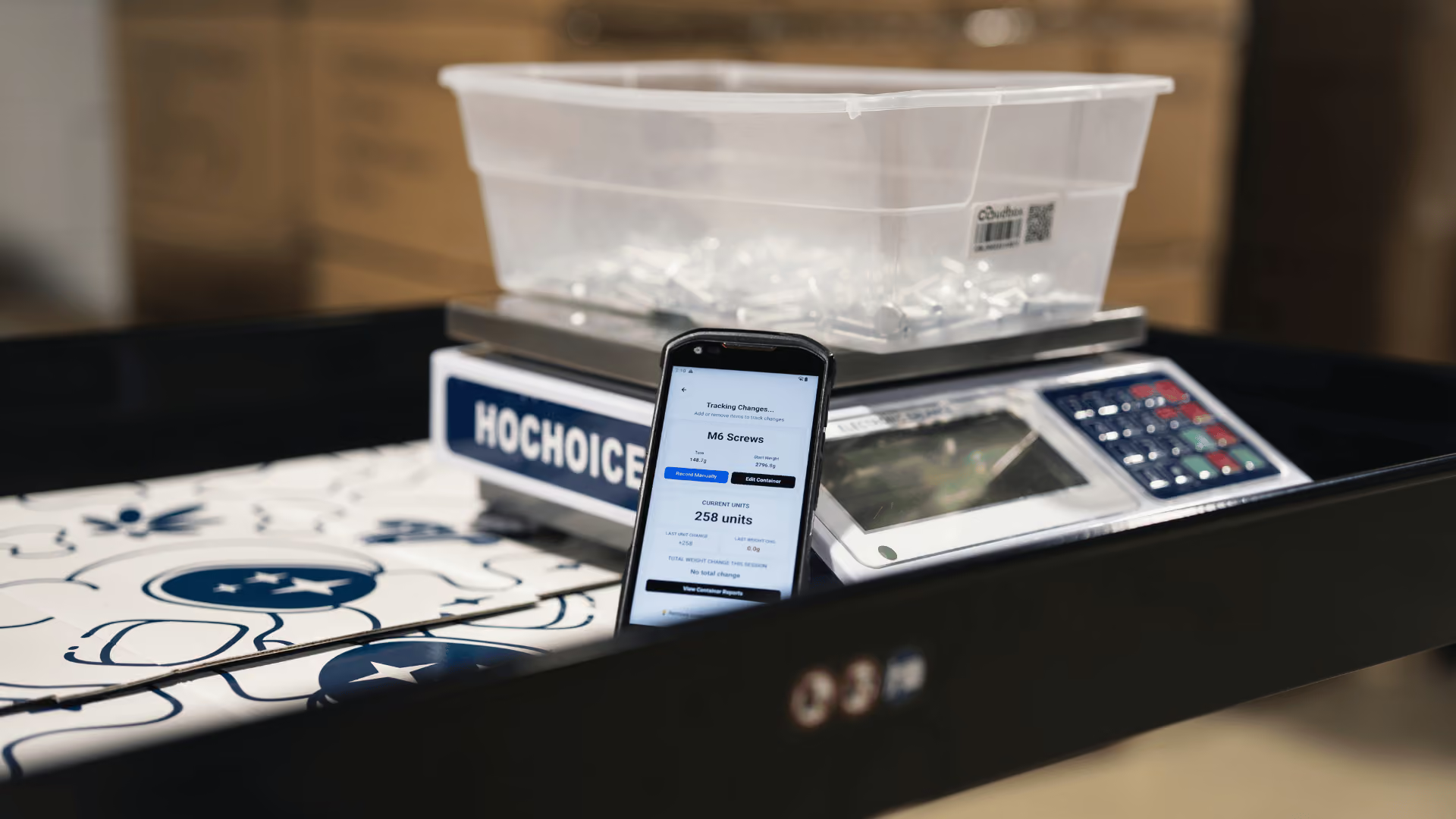
Cloudbox is scale-based inventory automation using smart container technology, and the station is mobile for exactly this reason. The picker rolls it to the bin location, scans the SKU with a Zebra Android scanner, and drops units onto the station until the target count is reached. Because the unit weight for that SKU is on file from Step 2, the station knows how many units are on it at every moment. The picker watches the count climb and stops on the number. One station serves a whole rack of SKUs, so this is not a scale per container, and it is not a fixture you build into your racking.

Overfulfillment stops because there is nothing to round up to. Underfulfillment stops because the station tells the picker they are short before the tote goes on the pallet. The pick workflow itself does not change: same bin, same tote, same release.
The instinct in fastener houses is that the parts are too small and too similar for weight to catch anything. It runs the other way. Visual verification fails hardest exactly where two SKUs differ by a thread pitch and nothing else. A division sized to the part does not care what the part looks like.
Pro tip: match station capacity to your SKU profile before you deploy. Heavy-gauge bulk stock needs floor-scale capacity. A light-parts catalog runs on a bench configuration. Capacity mismatch is the most common reason a pilot reads as a failure.
Deduct what actually left the shelf.
Most WMS and ERP stacks deduct on release: the system takes the quantity the order asked for and reduces inventory by that number, whether or not that is what the picker put in the tote. Inventory in the system is therefore a record of intentions. Weight-based picking gives you a record of events instead, and the value only lands if that record is what syncs back. The Cloudbox API is the piece that carries it.
This is also the fix for the multi-warehouse replenishment gap. Acumatica and most of its peers trigger a reorder on total on-hand across the company, not per location. So Warehouse A hits reorder at 50 units while Warehouse B sits on 300 of the same SKU, and a purchase order goes out instead of a transfer. Per-location counts that are current rather than end-of-month turn that into a transfer decision.
Pro tip: before you wire anything up, decide what happens when the measured count and the ordered count disagree. Does the line ship short with a flag, or does it hold? Make that an operating rule, not a decision each picker makes at the bin.
Stop reporting one accuracy percentage.
Report four numbers instead: shortage claim frequency and cost, measured overfulfillment by unit value, order accuracy rate, and time-to-discovery, meaning how long between an error happening and your system noticing. That last one is the metric nobody tracks and the one that governs everything else. At 30 days you carry a month of compounding exposure on every transaction. Under an hour, each event is trivial.
Gross margin per order is where this lands for ownership. Overfulfillment is a direct margin transfer to your customer, and chargeback prevention on the shortage side is cash you keep. Both show up in the same four numbers.
Fixing receiving accuracy and stopping there. Clean receiving with no shipping verification just means you know precisely what you had before you gave some of it away.
Treating kitting verification as the same problem. A kit has a bill of materials and a mixed total weight. It needs its own target, built from the component weights, not a single SKU divisor.
Letting bin location accuracy slide. Weight tells you how many. It does not tell you that someone restocked 3/8-16 into the 3/8-24 bin. Keep the scan.
Piloting on your cleanest SKUs. Pick the ones that generate claims. That is where the payback is visible inside a quarter.
Start with Step 1 this week. You can run it with the scales and spreadsheets you already own, and the number it produces is the business case for everything after it. When you want to see what the station does at the pick face, the Cloudbox scale lineup is the page worth reading next.
Stop relying on hand counts. Build a verified unit weight for each SKU from a 100-piece sample, then weigh the pick instead of counting it. A mobile scale station at the bin location gives the picker a live count that stops on the ordered quantity, which removes both overcounts and shortages.
Underfulfillment generates a claim, so you find out about it. Overfulfillment never does. Extra units leave in the customer's tote, the order closes clean, and the loss surfaces months later at year-end count as shrinkage nobody traces back to picking.
Most ERPs trigger reorders on total on-hand across all locations, so one warehouse can hit its reorder point while another sits on surplus. Counts that update as product leaves the shelf give you current per-location numbers, which turns a purchase order into a stock transfer.
Yes, and that is where it helps most. Visual checks fail when two SKUs differ only by thread pitch or finish. A scale with a division sized to the part reports the count regardless of how similar the parts look.
It depends on the lightest part you need to resolve. NIST Handbook 44 Section 2.20 sorts commercial devices into classes I through IIII and sets each one's verification division. Size the division to the difference you need to catch, not to the heaviest pallet you plan to weigh.

.png)